


 뉴욕타임즈
뉴욕타임즈


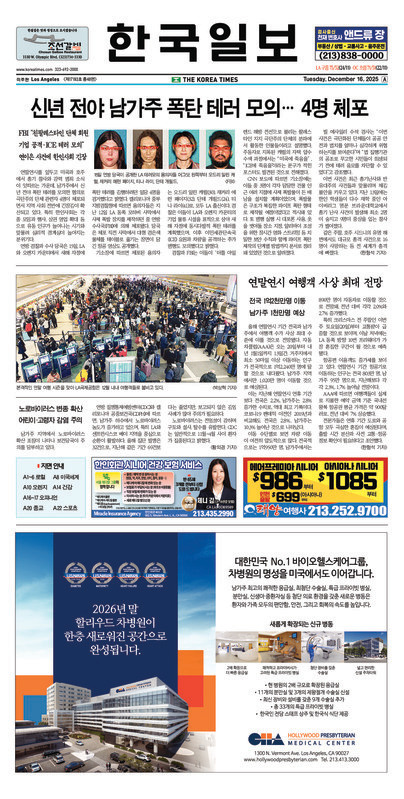
- 신년 전야 남가주 폭탄 테러 모의… 4명 체포
- 연말연시 여행객 사상 최대 전망
- 노로바이러스 변종 확산 어린이·고령자 감염 주의
- 캘리포니아 플라스틱백 퇴출 앞두고… 대형 체인, 종이봉투로 속속 전환
- 시드니 총격 테러 IS 연관 수사확대
- 취임 1년 앞두고 기세 꺾인 트럼프
close

- 모기지 금리, 내년에도 인하 ‘찔끔’ 전망
- SEC, 트럼프 취임 후 암호화폐 소송 중단
- 뉴스타부동산그룹, 창립 37주년 송년모임·시상식 성료
- 뉴욕증시 하락 마감 AI 회피 심리 지속
- [존청 변호사의 “경제·법률 핫이슈”] 세금으로 사라질 돈… ‘가족 재단’으로 유산 만든다
- 12월 주택시장지수 개선… 예상치 상회
close

- 이재성, 김민재 앞에서 환상 헤딩골… 마인츠, 뮌헨과 2-2
- ‘그랜트+샤프 70점’ 포틀랜드, ‘커리 48점’ GSW 격파
- 옥태훈·배용준·노승열, PGA 도전 고배
- 한국 3월 A매치 상대 한 팀 사실상 확정... 오스트리아 감독 ‘평가전 인정’
- 역시 호날두! 북중미 WC 인기 티켓 1위는? 포르투갈-콜롬비아전... 3위가 한국-멕시코전 “개최국 효과”
- ‘지독한 플래툰’ 김혜성도 71G 뛰었는데, 美 팬그래프 ‘송성문 ML 36G 타율 0.251’ 예상
close

- 생면, 치즈, 후추로만 만들어도 맛있다… 편안한 음식의 특별한 맛
- “전자레인지에 돌리지 말라”… ‘이것’ 넣으면 1급 발암물질
- 겨울 되니 ‘이 바이러스’ 돌아왔다… “변기 뚜껑 닫고 물 내려야”
- ‘이 과일’ 먹고 소변 검사했더니 ‘깜짝’
- 슬기로운시니어생활 44회
- 묵직한 카레는 가라… 점심마다 줄 서는 ‘향신료 카레’
close

- 대학 진학에 도움되는 AP… 적합한 과목 적절히 선택해야
- 속속 발표되는 조기전형… 지원자 능력·복합적 요소
- 코끼리에게 배우는 기억의 힘
- 아이비리그 합격 가르는 것은 ‘스펙’ 아닌 ‘습관’
- 슈퍼커리큘러로 열정을 깨워 보세요
- 재정보조 테크닉보다 타이밍의 중요성
close

- 황반변성=노인병? 아니었다… 2030 시력 위협하는 뜻밖의 원인
- 치아 교정 똑같이 받아도… 50대 아빠가 엄마보다 만족, 왜
- 연말연시 과음 후 속쓰림…단순숙취? “급성염증 신호일수도”
- 푹 쉬어도 판다처럼 짙어지는 ‘다크서클’… ‘이 병’ 때문일수도
- 위암 수술의 재발견… 암·대사질환 막는 ‘신의 한 수’ 될 수도
- “달리기 중 갑자기 실신”… 소아청소년 심정지 위험 신호
close

- 세렝게티에서 맞닥뜨린 버팔로 구출작전… 온몸에 전율
- [주말 뭐 볼까 OTT] 세 번째 수수께끼, 신앙의 무게 짊어진 고딕 미스터리의 귀환
- 다시 돌아온 주토피아… 차이를 넘어선 우정의 진화
- [새 영화] 고립된 차에서 구원 요청하는 5세 소녀와 구조요원들의 다큐 드라마
- ‘아름답고 달콤 씁쓸한 못 이룰 사랑 이야기’
- ‘원조 K굿즈’ 도자기 고장 이천, 달항아리에 내 손길 새겨볼까
close

- “리모델링하면 집값 오르겠지?”… 지나치면 ‘역효과’
- 주택보험료, 2027년까지 16% 인상 전망… 주거비 압박 심화
- 준비된 바이어·셀러가 성공하는 부동산 시장
- “꼭 해야 할 부동산 자산 점검 5가지”
- ‘즉시 입주 가능?’… 자칫 불량 ‘레몬 하우스’ 일 수도
- “새인가, 비행기인가?”… 상공서 집 찍는 ‘AI 풍선’ 등장
close

- 전원주 “숙대 졸업 후 앞치마 입는 연기만..부끄러웠다” 고백
- 박미선, 유방암 투병 중 ‘日 지진’ 걱정.. “건강하셔야 한다”
- 뉴욕 센트럴파크에 ‘뷔 벤치’ 생겼다
- “뜨거운 음료 사 와서, 후배 때려”..팝핀현준 ‘폭행 미투’ 터졌다
- “피고소만 5건” 박나래 ‘주사이모’ 고발 건, 검찰서 경찰로 이첩..왜?
- 박나래 ‘링거·주사 이모’ 난리통 속 결국..MBC ‘팜유트립’ 제작 무산
close
A Mason-Dixon Line of Progress


We saw our own version of this allegory with the two Americas this week — one going backward, the other stepping into tomorrow. We saw a retreat to bigotry in states dooming themselves to decline. And in other states, we saw a way for people to get around a do-nothing Congress controlled by Know-Nothing throwbacks.
First, the good. On Monday, Gov. Andrew M. Cuomo signed a bill that will eventually raise the minimum wage to $15 an hour, lifting the earnings of 2.3 million New Yorkers, and he authorized one of the strongest paid parental leave laws in the nation. On the same day, Gov. Jerry Brown of California put his signature to a $15 minimum wage plan in the most populous state. Then San Francisco became the first place in the United States to require businesses to provide paid leave for new parents.





What had seemed impossible just a few years ago is now rolling through cities and states led by forward-looking politicians. Together, these changes amount to a “revolution in the workplace,” as one exultant activist put it. But let’s not get too excited: The United States remains the only developed country in the world that does not mandate paid parental leave.
Now, the bad. Following North Carolina’s lead, another state, Mississippi, passed a law allowing people and institutions to deny services to gay people. With this measure, Mississippi, already one of the poorest states in the nation, ensures that good job providers will stay away.
Indeed, PayPal dropped plans to bring 400 jobs to North Carolina after politicians gave people a green light to discriminate. And a host of corporate leaders signed a letter on Wednesday explaining why Mississippi and North Carolina would be shunned. “Such laws are bad for employees,” the representatives of companies ranging from Whole Foods to General Electric wrote, “and bad for business.”Next door, in Alabama, the embattled Republican governor signed a bill earlier this year preventing cities from raising the minimum wage. This after Birmingham dared to dream of a day when its lowest-paid workers could make $10 an hour.
Nearly all the states with the highest percentage of minimum wage workers — full-time jobholders making $290 a week, before taxes — are in the South. These are also the same states that refuse to expand Medicaid to allow the working poor to get health care. And it’s in the same cradle of the old Confederacy where discriminatory bills are rising. Don’t blame the cities; from Birmingham to Charlotte, people are trying to open doors to higher wages and tolerance of gays, only to be rebuffed at the state level.
Essentially, this Republican-controlled block has decided that it’s better to be poor, sick and bigoted than prosperous, healthy and open-minded. And its defense is precisely that: The region is too economically distressed and socially backward to accept progress, so why change? Discrimination, as they see it, is just another term for religious freedom.
Raising the minimum wage is not a panacea, as Governor Brown noted. But he called it a moral imperative, one that will allow full-time workers at the low end to better provide for their children. In California and New York, the new laws have flexibility, either by region, or size of business, or during the phase-in period.
Good companies feel the same way. Costco just announced that it would raise entry-level wages to $13.50 an hour — at a cost to stockholders of a penny a share in the current quarter. One penny. Twitter will soon start giving full-time employees 20 weeks of paid parental leave.
Lifting wages for low-end workers and bringing the United States into the 21st century on family leave should be no-brainers. And yet, Congress refuses to move on President Obama’s call for paid parental leave for federal employees, and will not raise the minimum wage beyond the paltry $7.25 an hour.
Still, people are blowing past the obstructionists. Since Obama first called on Congress to move forward on wages, in 2013, 18 states and at least 40 cities have acted on their own. Expect to see family leave laws ripple across the land as well.
“The nation is alive from the bottom up,” Lt. Gov. Gavin Newsom of California told my colleague Thomas Fuller. “For all the disproportionate focus on Washington, D.C., there’s a whole other America out there, and it should give pause to the pessimists.” Indeed, a new poll found that 44 percent of California residents approve the Legislature’s job performance — compared with a 14 percent approval rating for Congress.
Now, maybe paying the working poor a little more will be a job-killer, as Republicans assert. Maybe mandating parental leave will inhibit business start-ups. Sure. If you believe doing nothing, in the wake of 20 years of declining wages and a harder quality of life, is better than doing something, this is your home: the geography of despair.
<TIMOTHY EGAN>
로컬뉴스
more
“청년 통해 한반도 평화통일 희망 보았다”
‘민주평통 2025 세계 청년위원 컨퍼런스’가 지난 11일-13일까지 가든그로브에 있는 하얏트 리젠시 오렌지 카운티 호텔에서 오렌지·샌디에고 …

“2026년에도 잘 해 봅시다”
OC 한인 상공회의소(KACCOC)는 이중열 제48대 신임 회장을 중심으로 내년 상공회의소를 이끌어갈 새 회장단을 지난 11일 공식 발표했다.…
어준호군 크로스 컨추리 11세 부문서 1등 차지
어바인에 있는 캐년 뷰 초등학교에 다니는 어준호군(11세)이 지난 13일 인디에나에서 열린 주니어 올림픽 크로스 컨추리 챔피언십 대회에 참가해…
한미가정상담소 미술심리 힐링 개최
한미가정상담소(이사장 수잔 최)는 내년 1-6월까지 매달 1, 3째주 금요일 오전 9시30분부터 11시까지(단 1월만 1, 9, 23일 미팅)…
새미 리 박사 ‘OC명예의 전당’ 올라
올림픽 금메달리스트이자 다이빙 영웅 새미 리 박사가 한인으로서는 처음으로 오렌지카운티 명예의 전당에 올랐다. OC수퍼바이저 위원회(위원장 덕 …
사람·사람들
more![[송년행사 화보] “한 해를 마무리하며… 화기애애한 송년의 순간들”](http://mimg.koreatimes.com/200/120/article/2025/12/15/20251215195255695.jpg "[송년행사 화보] “한 해를 마무리하며… 화기애애한 송년의 순간들”")
[송년행사 화보] “한 해를 마무리하며… 화기애애한 송년의 순간들”
LA 러너스클럽LA 러너스클럽(회장 김두병)은 13일 작가의 집에서 80여명의 회원과 가족이 참석한 가운데 송년회를 마쳤다. 2007년 창립된…
![[송년행사 화보] “웃음과 감사 가득 ‘훈훈’… 함께해서 행복”](http://mimg.koreatimes.com/200/120/article/2025/12/14/20251214204413695.jpg "[송년행사 화보] “웃음과 감사 가득 ‘훈훈’… 함께해서 행복”")
[송년행사 화보] “웃음과 감사 가득 ‘훈훈’… 함께해서 행복”
한국학교총연합회미주한국학교총연합회(회장 이영숙)가 주최한 제43회 장기 근속교사 포상 및 송년의 밤 행사가 140여명의 교사들이 참석한 가운데…
[송년행사 화보] “친구야 반갑다… 선배님들 모두…
경남중고경남중·고등학교 남가주 동창회(회장 예해덕)는 지난 6일 송년회를 열고 동문 및 가족 60여 명이 참석한 가운데 끈끈한 우정을 확인했다…
송년행사 게시판
월남전 참전자회월남전 참전자회 캘리포니아지회(회장 김종식)가 오는 17일(수) 오전 11시 LA 한인타운 해피음악원(2426 W. 8th St…
[송년행사 화보] “올 한 해 보람 가득… 내년에…
서강대남가주 서강대 동문회(회장 이정은·이사장 이찬근)의 2025년 정기총회 및 송년의 밤 행사가 지난 6일 웨스트리지 골프클럽에서 열렸다. …
한국일보 안내광고
- 렌트/리스/하숙
- 구인구직
- 중고차
- 전문업체



- 1
 머스크, 내년 중간선거 앞두고 공화당에 정치…
 - 2
 김건희특검, ‘로저비비에 선물’ 김기현 자택…
 - 3
 “매장 냉동고에 알몸 상태 여의사 시신 발견…
 - 4
 트럼프 “CBS 더 나빠져” 파라마운트에 불…
 - 5
 트럼프 “베네수정권, 테러단체지정…오가는 제…
 - 6
 “美日, 5천억 달러대 투자펀드 첫 사용처로…
 - 7
 호주 총격범과 몸싸움 끝에 숨진 60대 부부…
 - 8
 강경화 대사, 트럼프에 신임장 제정…트럼프,…
 - 9
 ‘유례없는 홍수’ 워싱턴주서 차량 침수돼 운…
 - 10
 “내가 먼저 죽으면 어머니 간병은… “79세…
- 11
 “뜨거운 음료 사 와서, 후배 때려”..팝핀…
 - 12
 캘리포니아 플라스틱백 퇴출 앞두고… 대형 체…
 - 13
 출퇴근길에 갇힌 한인들… ‘시간·건강·돈’ …
 - 14
 마지막 페니…올해 찍은 1센트 동전 232세…
 - 15
 한인 팔레스타인 활동가 체포
 - 16
 “그동안 감사” 피아니스트 임동혁, 극단 선…
 - 17[화요칼럼] 크리스마스 트리의 추억
- 18
 테슬라 주가, 또 3% 올라 사상 최고치 경…
 - 19
 여성운동가들에 거친 욕설 마크롱 부인, ‘어…
 - 20
 “얼굴 망가지면 다른 남자 못 만날 것”…태…
- 21
 美, 시리아·남수단 등 5개국 전면 입국 금…
 - 22미 전국서 50세 이상 살기 좋은 곳
- 23
 트럼프 “난 술 안 마시나 마셨으면 중독됐을…
 - 24
 백악관 비서실장 “관세 정책에 엄청난 내부 …
 - 25
 김하성 ATL과 전격 계약 ‘1년 2000만…
 - 26
 트럼프 “17일 밤 대국민연설”…지지율 하락…
 - 27
 ‘단골 손님’ 박나래·이이경은 없었다..MB…
 - 28
 착한 일만 하면 천국 간다?… 교인 상당수 …
 - 29
 ‘尹 관저이전 특혜’ 김오진 前국토차관 구속…
 - 30
 고용시장 얼린 ‘셧다운 한파’…11월 실업률…









오피니언
 노세희 부국장대우·사회부장
 커뮤니티 재단과 한인사회의 미래
 민경훈 논설위원
햄닛과 햄릿, 그 죽음에 대한 명상
 한형석 사회부 부장대우
 연말, 사기범들의 최대 성수기
 정유환 수필가
 [화요칼럼] 크리스마스 트리의 추억
- 이영창 / 한국일보
[지평선] 대통령의 ‘디테일’ 욕심
 이생진
이생진 ‘벌레 먹은 나뭇잎’
 옥세철 논설위원
오늘의 베네수엘라가 내일의 동아시아국가…

퇴조의 핑크 타이드
- 조지 F·윌 워싱턴포스트 칼럼니스트
[조지 F. 윌 칼럼] 대통령의 전쟁수행권
지사별 뉴스

송미숙 뉴저지한인회장 선출
32대 뉴저지한인회장에 송미숙 전 뉴저지한인회 이사장이 선출됐다.뉴저지한인회선거관리위원회는 15일 선관위 사무실에서 32대 회장선거에 단독 입…
25년이상 운영‘식당’에 세제혜택 추진

워싱턴 일원 유대인 커뮤니티 ‘비상’
지난 14일 호주에서 유대인들을 대상으로 대규모 총기 난사 사건이 발생한 가운데, 워싱턴 일원 유대인 커뮤니티를 중심으로 경찰 경비가 대폭 강…
미 전국서 50세 이상 살기 좋은 곳

캘리포니아 플라스틱백 퇴출 앞두고… 대형 체인, 종이봉투로 속속 전환
내년 1월 1일부터 캘리포니아 전역의 마켓과 식료품점에서 플라스틱 봉투가 완전히 사라진다. 개빈 뉴섬 주지사가 서명한 SB 1053 법안이 본…
‘우미노시즈쿠 후코이단’ 감사 이벤트




















 | ||
|



- 로그인
- 회원가입
Koreatimes.com 서비스는 Ktown1st.com과 통합계정입니다. 계정이 없으신 분은 회원가입을 해 주세요.
.png)



댓글 안에 당신의 성숙함도 담아 주세요.
'오늘의 한마디'는 기사에 대하여 자신의 생각을 말하고 남의 생각을 들으며 서로 다양한 의견을 나누는 공간입니다. 그러나 간혹 불건전한 내용을 올리시는 분들이 계셔서 건전한 인터넷문화 정착을 위해 아래와 같은 운영원칙을 적용합니다.
자체 모니터링을 통해 아래에 해당하는 내용이 포함된 댓글이 발견되면 예고없이 삭제 조치를 하겠습니다.
불건전한 댓글을 올리거나, 이름에 비속어 및 상대방의 불쾌감을 주는 단어를 사용, 유명인 또는 특정 일반인을 사칭하는 경우 이용에 대한 차단 제재를 받을 수 있습니다. 차단될 경우, 일주일간 댓글을 달수 없게 됩니다.
명예훼손, 개인정보 유출, 욕설 등 법률에 위반되는 댓글은 관계 법령에 의거 민형사상 처벌을 받을 수 있으니 이용에 주의를 부탁드립니다.
Close
x